Bassin de la Villette
Back to all places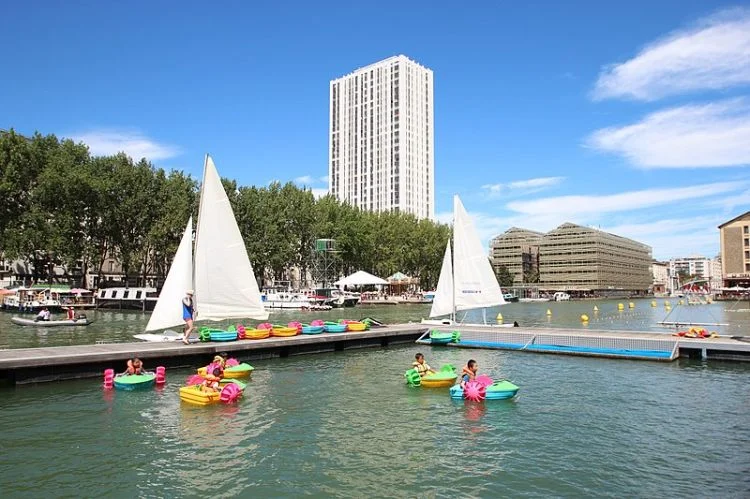
The Bassin de la Villette (La Villette Basin) is the largest artificial lake in Paris. It was filled with water on 2 December 1808. Located in the 19th arrondissement of the capital, it links the Canal de l’Ourcq to the Canal Saint-Martin, and it represents one of the elements of the Réseau des Canaux Parisiens (Parisian Canal Network), a public-works authority operated by the city. The other components of the network are the Canal de l’Ourcq, the Canal Saint-Denis, the Canal Saint-Martin, and the Bassin de l’Arsenal. Together, these canals and basins extend roughly 130 kilometres (81 mi).
Rectangular, eight hundred metres in length and seventy metres in width, it begins at the Rue de Crimée lifting bridge, the last bridge in Paris that can be raised and lowered hydraulically to permit the passage of ship and barge traffic beneath it, and it ends at the Place de la Bataille-de-Stalingrad near the Rotunda de la Villette. River cruise boats tie-up here and the shores of the basin are also the location of the MK2 Quai de Loire and MK2 Quai de Seine theatre complexes which are the most modern in France. A small electric passenger ferry, the Zéro de conduite, is available for transporting people from one side of the basin to the other. The basin is bordered in the north by the Quai de la Seine and in the south by the Quai de la Loire, which are linked in the middle of the basin by a footbridge, the Passerelle de la Moselle.
The first Bassin de la Villette is 699 metres long and 70 metres wide. It has served several functions. Its original function was to serve as a reserve of drinking water for Parisians. Its secondary function, in association with the second basin, was to provide water for navigation on the canals of Saint-Denis and Saint-Martin.
At the beginning of the 19th century the first basin was surrounded by gardens where Parisians came to spend pleasant interludes (walking in summer, skating in winter). But the industrial era of the 1850s saw the disappearance of this aspect of recreation. Goods depots were built on the banks. In 1832 Paris was hit by a great epidemic of cholera. Parisians using water from the Bassin de la Villette were less severely affected than those using water from the Seine (the Javel and Samaritaine steam pumps) because of waste waters being discharged into the river by the city - especially the waste of the Hôtel-Dieu de Paris, where there were many sick, which spanned the small arm of the river between the Ile de la Cité and the left bank. In the late 19th century, commercial activities developed at the basin. In the same period the Moselle footbridge (13 metres high and a span of 85 metres) was built by Armand Moisant. It was decorated with a clock 3 metres in diameter. This bridge was replaced in 1966.
The Lifting bridge of the Rue de Crimée or Pont de Flandre,Logo monument historique - rouge sans texte.svg a lifting bridge weighing 85 tons built in 1885, separates the two basins. It allows traffic on the Rue de Crimée to cross the canal and connects the Quai de l’Oise on the north-west side to the Quai de la Marne on the south-east side. When the bridge is raised pedestrian traffic can still continue on a fixed elevated walkway. At the time of its construction it was the third largest lifting bridge to be built in France. It is now the last one in Paris and is registered as an historical monument.
The second basin measures 30 m wide and 730 m long. This basin, which is often prematurely named the Canal de l’Ourcq, originally ran along the back of the old village of La Villette. At its northern end is the "roundabout of canals" where the Bassin de la Villette converges with the Canal de l’Ourcq (which brings water for more than 100 km from the river Ourcq) and the Saint-Denis canal which, with a length of 6,647.50 m and a slope of 28.45 m, joins the Seine at Saint-Denis, as well as the small Darse du fond de Rouvray canal (a port for the canal ferry boats).
https://en.wikipedia.org/wiki/Bassin\_de\_la\_Villette
Photo: Lionel Allorge
48.88593, 2.37529