Bois de Vincennes
Back to all places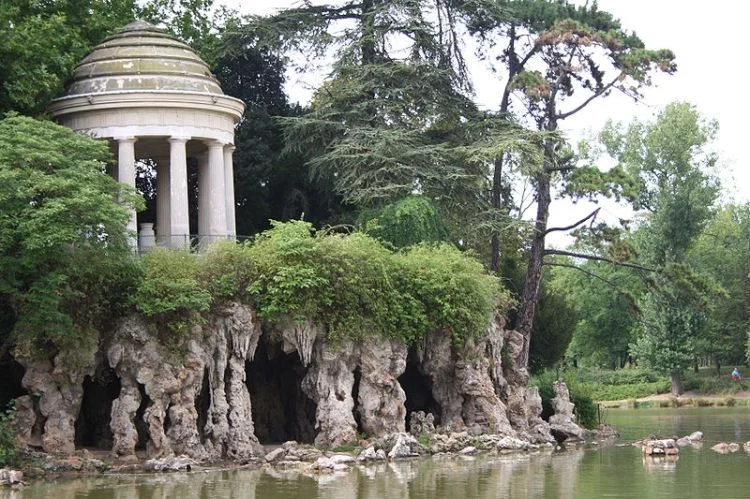
The Bois de Vincennes, located on the eastern edge of Paris, is the largest public park in the city. It was created between 1855 and 1866 by Emperor Napoleon III.
The park is next to the Château de Vincennes, a former residence of the Kings of France. It contains an English landscape garden with four lakes; a zoo; an arboretum; a botanical garden; a hippodrome or horse-racing track; a velodrome for bicycle races; and the campus of the French national institute of sports and physical education. The park is known for prostitution after dark.
The Bois de Vincennes has a total area of 995 hectares (2,459 acres), making it slightly larger than the Bois de Boulogne, (846 hectares / 2,091 acres), the other great Parisian landscape park located at the western side of the city. It occupies ten percent of the total area of Paris, and is almost as large as the first six arrondissements in the center of the city combined. The Bois de Vincennes is about three times larger than Central Park in New York City (341 hectares / 843 acres), and is slightly larger than Richmond Park in London (955 hectares / 2,360 acres); but is smaller than Griffith Park in Los Angeles (1,170 hectares / 2891 acres). Only about half of the Bois de Vincennes is covered with trees.
The bois de Vincennes was part of the ancient forest that surrounded the ancient Roman town of Lutetia; at that time it was called Vilcena, the origin of the present name. In about 1150 King Louis VII (1137–1180) built a hunting lodge at the site of the present chateau. King Philippe-Auguste (1180–1223) enclosed the forest with a wall, stocked it with game, and began building a castle. King Louis IX, or Saint Louis (1226–1270) built a chapel next to the castle to house an important religious relic, which he believed to be the crown of thorns from the Crucifixion of Jesus. He was also famous for holding a royal court of justice under an oak near the chateau.
In 1336 King Philip VI of France (1293–1350) began construction of the imposing donjon of the Château de Vincennes. The work was continued by his successor, Jean II of France (1319–1364), and finished by Charles V of France (1338–1380), who surrounded the donjon with a rectangular wall flanked by nine towers. He also began to rebuild the chapel founded by Saint Louis. The new chapel was called La-Sainte Chapelle, modeled after the Saint-Chapelle in the Palais de la Cité in Paris. It was not finished until the 16th century. A hunting party in the forest is shown as the December scene in the Très Riches Heures du Duc de Berry (1412–1416), with the towers of the chateau visible in the background. The forest was also the home of a community of monks of the order of the Minimes; their presence is remembered by the name of the Lac des Minimes within the park.
In 1654 Cardinal Mazarin commissioned the royal architect Louis Le Vau to build a new palace for King Louis XIV next to the chateau. The new palace featured a pavilion for the King and another for the Queen, separated by a portico and by a wall connected by arcades to the medieval section of the chateau. The donjon had been transformed into prison in the 15th century. The palace was popular with the King for a time, but once Louis XIV established his residence at Versailles, the château of Vincennes was rarely used.
In the 18th century Louis XV (1710–1774) opened the park to the public, excepting servants in livery. He had hundreds of trees planted and laid out long straight alleys through the forest in the form of intersecting stars. In 1731 he constructed a pyramid-shaped monument to mark the meeting point of the two main alleys, which can still be seen.
https://en.wikipedia.org/wiki/Bois\_de\_Vincennes
Photo: Georges Seguin (Okki)
48.82828, 2.43310