Conciergerie
Back to all places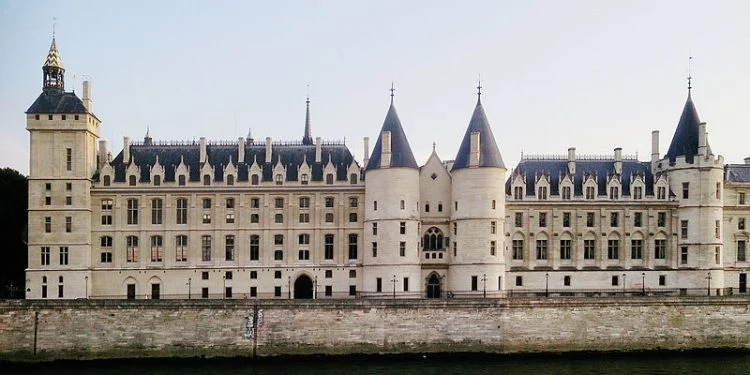
The Conciergerie is a former courthouse and prison in Paris, France, located on the west of the Île de la Cité, below the Palais de Justice. It was originally part of the former royal palace, the Palais de la Cité, which also included the Sainte-Chapelle. Two large medieval halls remain from the royal palace. During the French Revolution, 2,780 prisoners, including Marie-Antoinette, were imprisoned, tried and sentenced at the Conciergerie, then sent to different sites to be executed by the guillotine. It is now a national monument and museum.
In the 1st-3rd century AD, the Ile de la Cité became part of the Gallo-Roman city of Lutetia, on the opposite bank of the Seine. The island was surrounded by a wall, and a fortress of the Roman governor was built at the west end of the island. The Merovingian king Clovis installed his capital there, on the site of the Roman fortress. from 508 until his death in 511. The Carolingian monarchs moved their capital out of the city, but at the end of the 10th century, under Hugh Capet, Paris became the capital of the Kingdom of the Franks. He constructed a large new fortified residence, the Palais de la Cité, on the same site.
The four medieval towers of the north facade, along the Quai de l’Horloge between the Cour de Cassation and the Boulevard du Palais, are the most prominent exterior vestiges of the old Conciergerie.
The Tour Bonbec is a circular tower with battlements and a conical slate roof located at the west end of the Conciergerie, next to the Cour de Cassation. It is the oldest of the towers, constructed in the 13th century under Louis IX. It was originally one level shorter than the other towers, but in the 19th century, under Napoleon III, it was raised to its present height and form. The name of the tower comes from "Bon Bec," a slang word for a "Good talker". It is reference to the torture chamber, which during the Reign of Terror was located in this tower; it referred to those prisoners who spoke freely under torture.
The gateway on the north is flanked by two circular towers with conical roofs, but without battlements. The Caesar Tower, on the left facing the building, is named in honor of the Roman Emperors, particularly Julius Caesar who visited the island during the Gallic Wars to meet with the leaders of the Gallic tribes, and the later Emperors and Roman governors who lived on the island. The two towers were constructed in the early 14th century by Philippe IV. Later in the 14th century, the lower portions of the towers were connected to the prison of the Conciergerie, and were used as dungeons until the French Revolution. The Silver Tower on the right was used to store part of the royal treasury. After the court moved to Versailles, The upper parts of the two towers were attached to the Grand Chamber of the Parliament, and were used to store the civil and criminal registries of the Kingdom. In 1793–94, at the height of the Terror, the chief prosecutor of the Revolutionary Tribunal, Antoine Fouquier-Tinville, had his offices in the two towers, close to the courtroom of the Tribunal.
The most recent tower is the Tour de l’Horloge, or clock tower, at the corner of the Boulevard du Palais and the Quai de l’Horloge. It was completed by Jean II of France, and finished in 1350. It is the tallest tower of the Conciergerie, five levels high, with battlements and a lantern tower at the top; it served as both a watchtower and clock tower. The clock was installed during the reign of Charles VI of France, and was the first public clock in Paris. In 1585 King Henri III of France embellished the clock with a new face, set on a blue background with gold Fleurs-de-lis, and framed by statues of law and justice by sculptor Germain Pilon. The decoration was vandalised during the Revolution, and the large bell in the lantern, which was rung to celebrate major events, was taken out and melted down. The tower had been restored several times, most recently in 2012.
The current facades were built later than the towers. The North facade between the towers was built in the 19th century in Gothic Revival style. The eastern section, around the entrance, was built during the Bourbon Restoration in the early 19th century, while the western section was built by Joseph-Louis Duc and Étienne Théodore Dommey in the second half of the 19th century, under Emperor Louis Napoleon. They were almost completed in 1871, when the Paris Commune took charge of the city. The Commune set the building on fire in the last days of the Commune, badly damaging the interiors, but it was rebuilt in the late 19th century.
https://en.wikipedia.org/wiki/Conciergerie
Photo: xandru
48.85601, 2.34550