Grande Arche de la Defense
Back to all places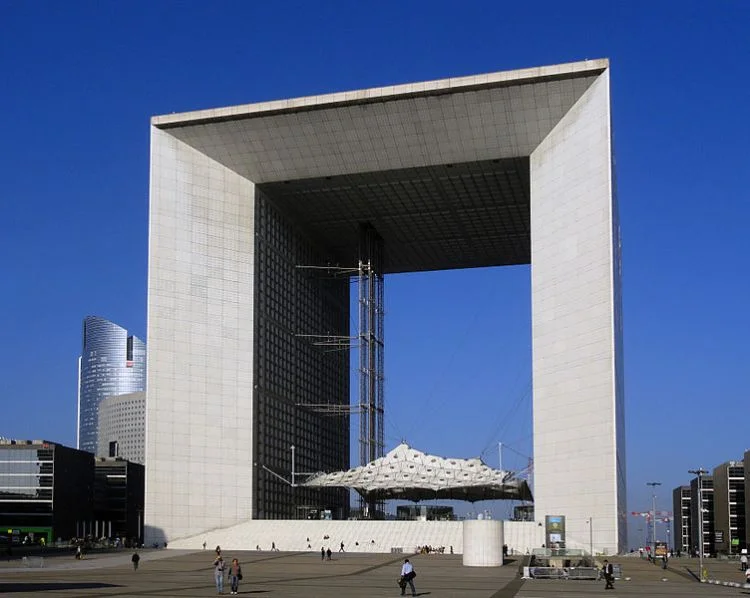
After months of renovation, the Grande Arche in the La Défense district of Paris is now open again to the public. It was originally designed by the architect Johan Otto V. Spreckelsen. Its renovation was managed by the architectural firm Valode & Pistre.
The Grande Arche is an important, modern architectural landmark that is part of the “historical axis” of Paris. Also known as the “Triumphal Way”, the historical axis is a line of monuments, buildings and avenues running from the Louvre Museum in the center of Paris all the way up the Champs Elysees and past the Arc de Triomphe before ending at the Grande Arche. Shaped like a door that opens out into the world, the extremely modern design of the Grande Arche is highly original and must be experienced in person. It is grandiose, intense and unique – words cannot describe it!
There are many things to see and do at the Grande Arche, located in the heart of Paris, the ultimate city destination in France. This mysterious and symbolic monument dominates the skyline of central Paris and can be seen from the Louvre pyramid.
The Grande Arche was inaugurated on July 14, 1989 in the year of the bicentenary of the French Revolution and on the occasion of the G7. It was initially called “La Grande Arche de la Fraternité” (The Great Arch of Fraternity). Its designer described it as a window onto the world. It is intended to function as a place where people with different backgrounds and cultures can meet and communicate. After the reopening of the Grande Arche, this original role has been updated and modernized to fit contemporary society.
The Grande Arche came into being through an architectural competition held in 1982. It was initiated by François Mitterrand as part of his “Great Works of Paris” plan.
The Grande Arche does not stand completely straight. Like the Louvre pyramid, it leans slightly away from its axis by six and a half degrees. The Grande Arche is constructed as a bridge elevated 110 meters in the air and supported by 12 pillars. It overlooks the plaza of La Défense and the surrounding districts of the city of Paris. 300,000 tons of materials were required to construct the monument (equivalent to 30 times the weight of the Eiffel Tower). Glass and granite were used for the façades and 125,000 000 m3 of concrete for the structure.
https://www.lagrandearche.fr/en/history
Photo: Coldcreation
48.89260, 2.23611