La Villette
Back to all places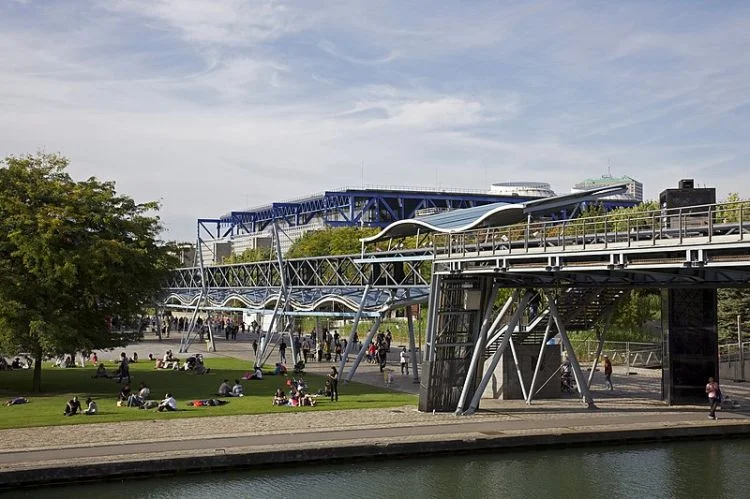
The Jardin du Luxembourg is the third-largest park in Paris, 55.5 hectares (137 acres) in area, located at the northeastern edge of the city in the 19th arrondissement. The park houses one of the largest concentrations of cultural venues in Paris, including the Cité des Sciences et de l’Industrie (City of Science and Industry, Europe’s largest science museum), three major concert venues, and the prestigious Conservatoire de Paris.
Parc de la Villette is served by Paris Métro stations Corentin Cariou on Line 7 and Porte de Pantin on Line 5.
The park was designed by Bernard Tschumi, a French architect of Swiss origin, who built it from 1984 to 1987 in partnership with Colin Fournier, on the site of the huge Parisian abattoirs (slaughterhouses) and the national wholesale meat market, as part of an urban redevelopment project. The slaughterhouses, built in 1867 on the instructions of Napoléon III, had been cleared away and relocated in 1974. Tschumi won a major design competition in 1982–83 for the park, and he sought the opinions of the deconstructionist philosopher Jacques Derrida in the preparation of his design proposal.
Since the creation of the park, museums, concert halls, and theatres have been designed by several noted contemporary architects, including Christian de Portzamparc, Adrien Fainsilber, Philippe Chaix, Jean-Paul Morel, Gérard Chamayou, on to Mr. Tschumi.
Since its completion in 1987, the Parc de la Villette has become a popular attraction for Paris residents and international travelers alike. An estimated 10 million people visit the park each year to take part in an array of cultural activities. With its collection of museums, theatres, architectural follies, themed gardens, and open spaces for exploration and activity, the park has created an area that relates to both adults and children.
Designed by Bernard Tschumi, the park is meant to be a place inspired by the post-modernist architectural ideas of deconstructivism. Tschumi’s design was in partial response to the philosophies of Jacques Derrida, acting as an architectural experiment in space (through a reflection on Plato’s Khôra), form, and how those relate a person’s ability to recognize and interact. According to Tschumi, the intention of the park was to create space for activity and interaction, rather than adopt the conventional park mantra of ordered relaxation and self-indulgence. The vast expanse of the park allows for visitors to walk about the site with a sense of freedom and opportunity for exploration and discovery.
The design of the park is organized into a series of points, lines, and surfaces. These categories of spatial relation and formulation are used in Tschumi’s design to act as a means of deconstructing the traditional views of how a park is conventionally meant to exist.
The Parc de la Villette boasts activities that engage all people of all ages and cultural backgrounds. The park is a contemporary melting pot of cultural expression where local artists and musicians produce exhibits and performances. On the periphery of the park lies the Cité des Sciences et de l’Industrie, the largest science museum in Europe. There are a convention center and an I-MAX theatre. The park acts as a connection between these exterior functions. Concerts are scheduled year-round, hosting local and mainstream musicians. Dividing the park is the Canal de l’Ourcq, which has boat tours that transport visitors around the park and to other sites in Paris. Festivals are common in the park along with artist conventions and shows by performers.
The Parc de la Villette hosts an annual open-air film festival. In 2010 the festival’s theme was "To Be 20" ("Avoir 20 ans") and featured films about youth and self-discovery around the age of 20. In 2010 films were shown by American filmmakers Woody Allen and Sofia Coppola as well as French and international filmmakers.
https://en.wikipedia.org/wiki/Parc\_de\_la\_Villette
Photo: Jean-Marie Hullot
48.89385, 2.39026