Louvre
Back to all places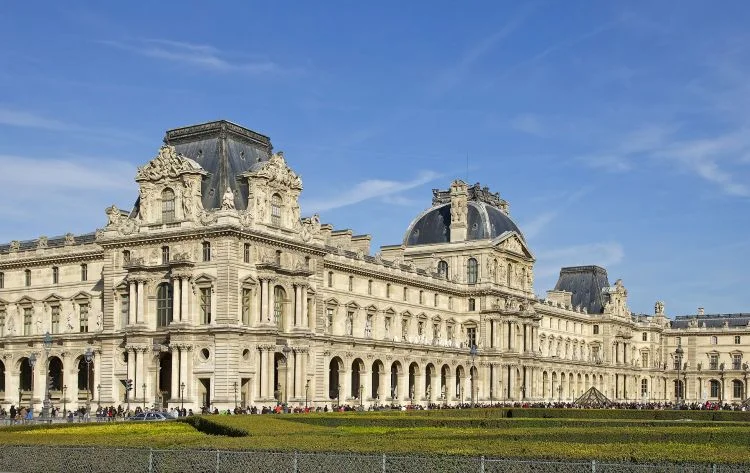
The Louvre Palace, often referred to simply as the Louvre, is an iconic French palace located on the Right Bank of the Seine in Paris, occupying a vast expanse of land between the Tuileries Gardens and the church of Saint-Germain l’Auxerrois. Originally a military facility, it has served numerous government-related functions in the past, including intermittently as a royal residence between the 14th and 18th centuries. It is now mostly used by the Louvre Museum, which first opened there in 1793.
Whereas the area had been inhabited for thousands of years, the Louvre’s history starts around 1190 with its first construction as a fortress defending the western front of the Wall of Philip II Augustus. The Louvre’s oldest section still standing above ground, its Lescot Wing, dates from the late 1540s, when Francis I started the replacement of the medieval castle with a new design inspired by classical antiquity and Italian Renaissance architecture. Most parts of the current building were constructed in the 17th and 19th centuries.
For more than three centuries, the history of the Louvre has been closely intertwined with that of the Tuileries Palace, created to the west of the Louvre by Catherine de’ Medici in 1564 and finally demolished in 1883. The Tuileries was the main seat of French executive power during the last third of that period, from the return of Louis XVI and his court from Versailles in October 1789 until the palace was set on fire during the Paris Commune of 1871. The Pavillon de Flore and Pavillon de Marsan, which used to respectively mark the southern and northern ends of the Tuileries, are now considered part of the Louvre Palace. The Carrousel Garden, first created in the late 19th century in what used to be the great courtyard of the Tuileries (or Cour du Carrousel), is now considered part of the Tuileries Garden. A less high-profile but historically significant dependency of the Louvre was to its immediate east, the Hôtel du Petit-Bourbon, appropriated by the monarchy following the betrayal of the Constable of Bourbon in 1523 and mostly demolished in October 1660 to give way to the Louvre’s expansion. The last remains of the Petit-Bourbon were cleared in the 1760s.
The Louvre Palace is situated on the right bank of the Seine, between the Quai François Mitterrand to its south, the avenue du Général-Lemonnier to its west (thus named since 1957; formerly rue des Tuileries and Avenue Paul-Déroulède, converted into an underpass in 1987–1989), the Rue de Rivoli to its north, and the Place du Louvre to its east. The complex occupies about 40 hectares with buildings distributed around two main open spaces: the eastern Cour Carrée (square courtyard), which is closed by four wings that form the square of its name, and the central Cour Napoléon, which is open on its western side, beyond the thoroughfare known as Place du Carrousel, towards the Carrousel Garden and the rest of the Tuileries Garden.
The Louvre is slightly askew of the Historic Axis (Axe historique), a roughly eight-kilometre (five-mile) architectural line bisecting the city. The axis begins with the Louvre courtyard, at a point now symbolically marked by a lead copy of Bernini’s equestrian statue of Louis XIV, and runs west along the Champs-Élysées to La Défense and slightly beyond.
https://en.wikipedia.org/wiki/Louvre\_Palace
Photo: Jebulon
48.86061, 2.33764