Orsay Museum
Back to all places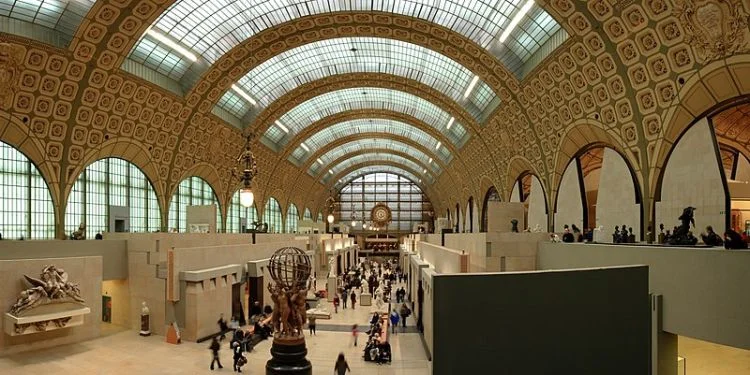
The Musée d’Orsay is a museum in Paris, France, on the Left Bank of the Seine. It is housed in the former Gare d’Orsay, a Beaux-Arts railway station built between 1898 and 1900. The museum holds mainly French art dating from 1848 to 1914, including paintings, sculptures, furniture, and photography. It houses the largest collection of Impressionist and post-Impressionist masterpieces in the world, by painters including Berthe Morisot, Claude Monet, Édouard Manet, Degas, Renoir, Cézanne, Seurat, Sisley, Gauguin, and Van Gogh. Many of these works were held at the Galerie nationale du Jeu de Paume prior to the museum’s opening in 1986. It is one of the largest art museums in Europe.
In 2021 the museum had one million visitors, up 30 percent from attendance in 2020, but far behind earlier years due to the COVID-19 pandemic. Despite the drop, it ranked fifteenth in the list of most-visited art museums in 2020.
The museum building was originally a railway station, Gare d’Orsay, located next to the Seine river. Built on the site of the Palais d’Orsay, its central location was convenient for commuting travelers. The station was constructed for the Chemin de Fer de Paris à Orléans and finished in time for the 1900 Exposition Universelle to the design of three architects: Lucien Magne, Émile Bénard and Victor Laloux. The Gare d’Orsay design was considered to be an "anachronism." Since trains were such a modern innovation for the time architects and designers alike expected a building that would embody the modern traits of this new mode of transportation. Gare d’Orsay instead gained inspiration from the past for the concept of the facade to the point of masking the cutting-edge technology within. It was the terminus for the railways of southwestern France until 1939.
By 1939 the station’s short platforms had become unsuitable for the longer trains that had come to be used for mainline services. After 1939 it was used for suburban services and part of it became a mailing centre during World War II. It was then used as a set for several films, such as Kafka’s The Trial adapted by Orson Welles, and as a haven for the Renaud–Barrault Theatre Company and for auctioneers, while the Hôtel Drouot was being rebuilt.
In the 1970s work began on building a 1 km-long tunnel under the station as part of the creation of line C of the Réseau Express Régional with a new station under the old station. In 1970, permission was granted to demolish the station but Jacques Duhamel, Minister for Cultural Affairs, ruled against plans to build a new hotel in its stead. The station was put on the supplementary list of Historic Monuments and finally listed in 1978. The suggestion to turn the station into a museum came from the Directorate of the Museum of France. The idea was to build a museum that would bridge the gap between the Louvre and the National Museum of Modern Art at the Georges Pompidou Centre. The plan was accepted by Georges Pompidou and a study was commissioned in 1974. In 1978, a competition was organized to design the new museum. ACT Architecture, a team of three young architects (Pierre Colboc, Renaud Bardon and Jean-Paul Philippon), were awarded the contract which involved creating 20,000 square metres (220,000 sq ft) of new floorspace on four floors. The construction work was carried out by Bouygues. In 1981, the Italian architect Gae Aulenti was chosen to design the interior including the internal arrangement, decoration, furniture and fittings of the museum. The arrangement of the galleries she designed was elaborate and inhabited the three main levels that are under the museum’s barrel vault atrium. On the main level of the building, a central nave was formed by the surrounding stone structures that were previously the building’s train platforms. The central nave’s structures break up the immense sculpture and gallery spaces and provided more organized units for viewing the art. In July 1986, the museum was ready to receive its exhibits. It took 6 months to install the 2000 or so paintings, 600 sculptures and other works. The museum officially opened in December 1986 by then-president François Mitterrand.
https://en.wikipedia.org/wiki/Mus%C3%A9e\_d%27Orsay
Photo: Benh
48.85996, 2.32656