Sacré-Cœur
Back to all places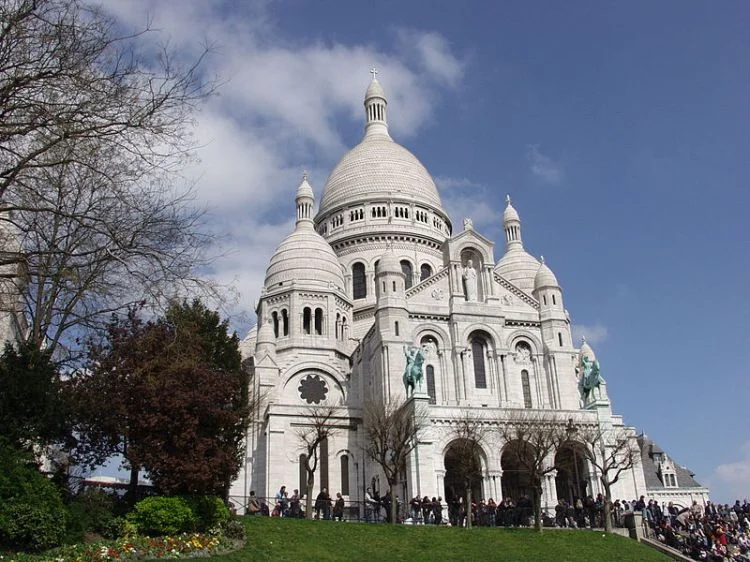
The Basilica of Sacré Coeur de Montmartre (Sacred Heart of Montmartre), commonly known as Sacré-Cœur Basilica and often simply Sacré-Cœur, is a Roman Catholic church and minor basilica in Paris, France, dedicated to the Sacred Heart of Jesus.
Sacré-Cœur Basilica is located at the summit of the butte of Montmartre. From the dome, two hundred meters above the Seine, it is possible to see all of Paris, and the countryside for fifty kilometres around, It is the second-most visited monument in Paris, after the Eiffel Tower. Sacré-Cœur Basilica has maintained a perpetual adoration of the Holy Eucharist since 1885.
The Basilica was first proposed by Felix Fournier, the Bishop of Nantes, on 4 September, 1870, following the defeat of France and the capture of Napoleon III at the Battle of Sedan, in the Franco-Prussian War, and six months before the Paris Commune. He blamed the defeat of France upon the "moral decline" of France since the Revolution, and proposed a new Paris church dedicated to the Sacred Heart of Christ.The site chosen was the butte of Montmartre, overlooking the whole city, and the traditional location of the martrydom of Saint Denis, the patron saint of Paris.
The basilica was designed by Paul Abadie, whose Neo-Byzantine-Romanesque plan was selected from among seventy-seven proposals. Construction began in 1875, and continued for forty years, under five successive architects. It was completed in 1914, but, because of World War I, it was not formally consecrated until 1919.
The site of the church was politically controversial, since Montmartre was also the site of beginning of the Paris Commune where, on March 18, 1871, Communard soldiers killed two French army generals and seized a park full of artillery. On the last day of the Commune, one of its leaders, the socialist and anarchist Eugène Varlin, was executed there There was (and remains) a feeling of resentment on the French left against the church.
The church is 85 meters long and thirty-five meters wide. It is composed of a large central rotunda, around which are placed a small nave, two transepts, and an advance-choir, which form a cross. The porch of the church has three bays, and is modelled after the porch of Périgueux Cathedral. The dominant feature is the immense elongated ovoid cupola, 83.33 meters high, surrounded by four smaller cupolas. At the north end is the campanile, or bell tower, 84 meters high, containing the "Savoyarde", the largest bell in France.
The overall style of the structure is a free interpretation of Romano-Byzantine architecture. This was an unusual architectural style at the time, and was in part a reaction against the neo-Baroque of the Palais Garnier opera house by Charles Garnier, and other buildings of the Napoleon III style. After the death of The construction was eventually handed on to a series of new architects, including Garnier himself, who was a counsellor for the Henri-Pierre-Marie Rauline between 1891 and 1904,
Some elements of the design, particularly the elongated domes and the structural forms of the windows on the south facade, are Neo-classical, and were added by the later architects Henri-Pierre Rauline and Lucien Magne.
https://en.wikipedia.org/wiki/Sacr%C3%A9-C%C5%93ur,\_Paris
Photo: Robert Breuer
48.88670, 2.34310